Rethinking the One Day Cup

Last month, I took a quick glance over the ECB Performance Review commissioned by Andrew Strauss. Whilst a lot of was deliberately vague and didn’t really address some of the broader issues impacting the domestic game (ie. The Hundred), some of the thoughts on the One Day Cup did catch my eye.

There were three ideas proposed. Make the group stage shorter, play more knockout cricket, and move the tournament to April. Each of these looks a good idea (though the latter would mean playing The Hundred and the County Championship simultaneously, which may or may not be a better compromise…).

The trouble with having 18 First-Class counties is that it doesn’t lead itself well to an effective tournament design. Eighteen teams can be divided into two group of 9, which leads to long group stages, or three groups of six, which results in awkward repechage conditions to arrive at a knockout stage.

Perhaps the solution is to increase the number of teams in the One Day Cup to 20. This of course means finding new teams, but that shouldn’t be hard to do. Previous editions of the One Day Cup have included invitational teams from Ireland, Scotland, The Netherlands, and a Minor County Select XI known as the Unicorns. Any two of these would be ideal to bring the total up to an easier-to-work-with number.

Or we could get more creative – ahead of their next World Cup campaign, why not give England U19s some extra high-level match practice in the One Day Cup? Or include the South Asian Cricket Academy (SACA), whose purpose is to break down the barriers preventing British South Asians from reaching professional cricket and have been frequently beating County 2nd XIs despite a tiny budget?

(N.B. we’re up to 24 teams if all these suggestions were included, which is also an easy to work with number, but we’ll stick with 20 for now. Basically, there are options.)

With 20 teams, we can now divide the teams into four groups of five. This would mean a single round-robin in each group providing four games per team, before moving to the knockouts. A double round robin would mean 8 games, which is no shorter than what we have now.

But eliminating teams after four games is not going to help players develop their skills in the 50 over game, and is not going to provide a representative picture for selectors. Therefore, we need to get creative without the knockouts.

Let’s not eliminate any team, but instead, sort them into brackets at the end of the group stage. The top two in each of the 4 groups would advance to the quarterfinals for the cup. The quarterfinals would be played, with the winners advancing to the semi-finals as normal. The losing quarterfinalists would play in playoffs for 5th through 8th place. A third-place playoff would be contested between the two losing semifinalists.

The same could be repeated for the teams finishing 3rd and 4th in their groups, leading to a playoff bracket contesting 9th through 16th places, and perhaps the awarding of a Plate Trophy. The teams finishing 5th in their group could play for 17th through 20th place through knockouts or a round-robin, providing a further two or three games.

This means every team plays three ‘knockout’ games each, for a total of 7 games per team per season. Every team would also have a finishing position between 1st and 20th, which could be incentivised by prize money to encourage teams to keep playing to win, even if they are out of the running for a trophy.

This therefore fits the brief – a shorter tournament, with fewer group stage games and more knockouts, applying stakes to every game. With every team getting seven matches each, this gives opportunity for players to make their case to selectors, but doesn’t create a draw out tournament.

What say, Andrew Strauss?

The Hundred, Part I – A new audience? Maybe…

Something tells me cricket isn’t just going to change overnight…

Last Thursday night I was at the first men’s game of the Hundred: Oval Invincibles vs Manchester Originals at The Oval. I didn’t really know what to expect, and I was pleasantly surprised to find a large group of fellow match-goers at the train station. Of the eight of them, three were adults and five were kids under ten. They were clearly already cricket fans of some description – two of the kids were wearing training shirts of my cricket club – but I was encouraged to see such a young group going to the game.

My encouragement was depleted by the time I got to the venue, however. As a I walked out of Vauxhall tube station, I found myself in a crowd of the more classic cricket fan. Replica shirts of the international, county and IPL variety were on display (myself? I was wearing an Adelaide Strikers shirt). And although there was some visible diversity – ethnic, gender and age – the crowd was predominantly white and male.

I sat next to a man and his godson, the former a semi-regular at the Oval and the latter at his first cricket game. Once again, I was encouraged that the ECB’s marketing had cut through to that fabled new audience, but the encouragement was short lived as the game progressed as the groups in front and behind of me became increasingly loud as they drank alcohol.

The atmosphere was rather typical for a T20. It has been a few years since I attended a Blast fixture at the Oval. Thursday’s crowd was similar to what I remembered. Perhaps a little younger, a little louder, a little more friendly.

True to the style of T20, it wasn’t long before the crowd broke out into song. ‘Please don’t take me home’ was a clear favourite of the punters, followed by ‘Sweet Caroline’. Songs adorning Gareth Southgate and Harry Maguire were also sung, a Euros hangover, perhaps?

The crowd’s voice contrasted with the DJ’s. There has been a clear directive from the ECB to modernise the choice of music to be played over the PA. Among the DJ’s playlist I noticed Royal Blood’s ‘Typhoons’. Now, I am a big Royal Blood fan, but their post-grunge sound is not best enjoyed whilst seated at a cricket game. The paying public did not take to the DJ’s choice of music (bar a few kids shown dancing on the big screens), and the DJ did not play to the crowd’s preferred songs. The contrast was jarring.

The DJs also get marked down for their placement. The DJ booth occupies the bulk of a stand at The Oval, in which no spectators can sit, reducing the venue’s capacity.

There is also the issue of the half-time act. Essentially, no-one cared. I couldn’t hear the name of the act over the PA when it was announced for the crowd, didn’t recognise the one song they played, and didn’t notice them leave the stage. The crux of the problem is that fans use the interval to talk to their friends, go to the toilet and purchase food and drink. No-one came to see a band they haven’t heard of play a single song.

The PA system was largely inaudible throughout. I had much anticipated the explainer videos that were going to introduce new fans to the rules of the game. I could barely here them over the crowd, and the video wasn’t enough on its own.

I also found the game difficult to follow. This is a criticism I can apply to the TV coverage as well: as an established cricket fan, the scoreboards did not provide me with enough information to follow the game the way I am used to. Of the two big screens, the one I could see best only showed runs scored and balls faced in the first innings or runs required and balls remaining in the run chase. The second screen resembled a more traditional scoreboard, but both kept flashing away to show replays and vox-pop children the stands.

The best was to follow the scoreboard on the dot-matrix board in the 1845 stand. Here, you could reliably find the batsman’s scores as well as the bowler’s figures, Missing, however, was any measure of run rate, either the current rate, the required rate, the batter’s strike rate or the bowler’s economy. These are stats I find extremely helpful when following the game, but they were not provided. Now, I have two maths A-levels, so it was within my grasp to calculate these for myself, but I found it challenging to retain all this information and still watch the actual cricket. God-only-knows how this works if you are less mathematically inclined than me. What I would give to have a worm-chart appear occasionally to show the progress of the game, but these have been dropped. I assume the marketing team (wrongly) find them too complicated.

Overall, the experience was enjoyable, but less so that a T20 Blast fixture. I found the DJ and half-time act was out-of-place, and the cricket harder to follow. My advice is that if you are an existing cricket fan, and are open-minded to The Hundred, the £25 ticket price is more than good value. If you have already decided you hate The Hundred, I do not expect you to listen to me and you should take your folding chair to whatever out-ground the One Day Cup is being played at.

Of course, cricket isn’t just going to change overnight, and neither are it’s fans. There are a few encouraging signs, particularly the viewing figures. But whether it translates to more, and particularly new, bums on seat is a question we won’t be able to answer for some time.

Most important, if you are a new cricket fan, or have been put off by the T20 atmosphere in the past, I would not recommend attending a men’s game. At least, I would recommend attending a women’s game, where the crowds will be smaller, quieter, and following the game will be easier.

I’ll cover my thoughts on the format and its wider impact on the game later in the competition.

The New County Championship?

On Friday, the ECB released their new format for next season’s county championship. The new design feels very much a blend of the 2019 running and the 2020 Bob Willis Trophy. The Bob Willis Trophy itself is repurposed as a single match at the end of the season.

For 2020, the teams are divided into three groups of six with the draw seeded based on their finishing position in 2020. Each team will play their opponents in their group twice, home and away. A total of 10 games. Simple so far.

The finishing positions from the group stage then determine the draw for the division stage. The top two in each group go into Division 1, 3rd and 4th into Division 2 and the last two into Division 3. Team will then play their opponents in their division they haven’t played in the group stage, 4 games in total, 2 home and 2 away. Presumably, points from the group stage will carry forward though it’s not currently clear in what capacity.

The winner of Division 1 is the County Champion, and a prize money distribution is proposed to keep all teams playing for positions until the end. The top two teams in Division 1 will then contest the Bob Willis Trophy, a one off, 5-day game.

The ECB stressed in their announcement that the new format was intended for 2021 only, and that returning to the old 2 divisions for 2022 was the ‘default’ position, subject to a review. Given reasons for this are that the 2021 format is flexible: in the event major COVID-19 disruptions the tournament can be easily shortened. The group stage can be cut to 5 games if required and the division stage can be eliminated entirely, reverting to the 2020 format if necessary.

Beyond that, the structure is clearly a balance of compromises, and something of an experiment. The Bob Willis Trophy, with it’s 3 short groups stages and winner-takes-all final was well received, and elements of that are mixed with the two-division system. There is something of an experimental vibe to it, especially in having two trophies up for grabs (and so five across all formats in the English summer).

I’ve heard the new structure described as complicated, but I really don’t think it is. There are in effect 3 stages to the red-ball summer under this proposal, but none of it is particularly complex.

In fact, I’d go as far as to say this is the breath-of-fresh-air County Cricket needs. The two-division system has almost entrenched a split between counties. Those that are richer and can afford to invest in players and facilities are regulars in Division 1. Those with fewer resources have been stuck in Division 2 for a long time. This has driven small counties to priorities white-ball competitions and not focusing on their first-class campaigns. This sees players move from Division 2 counties to Division 1 teams in the hopes of improving their England selection chances.

Since every team now has the same opportunity to win in any given season, these imbalances may be reduced. Case in point, Derbyshire led the North Group for most of the tournament, despite being a former Div 2 county.

Breaking the tournament into two stages may also work favourably. Since T20 takes up most of August, the group stage will be played early in the summer and the division phase is likely to be played in its entirety in September. A neat break could allow for new interest in division 1 come September (if it isn’t drowned out by football).

That’s not to say I think the new format is perfect, there are certain things that bother me. First is the Bob Willis Trophy itself. Whilst it’s a nice touch to keep it on, including the fitting tribute to the late Bob Willis, I have serious reservations about ‘knockout’ first-class cricket. I may be in the minority here; the final was well received last month. However, I feel that the win-by-first-innings rule that sees the title decided in a draw encourages negative play by the leading team in the 2nd innings. This was exemplified by Essex batting for a draw this summer. Further, examples exist in the Ranchi Trophy in India of teams taking time out of the game in the 3rd or 4th innings to confirm their advantage, by batting slowly or setting impossible 4th innings chases. I worry that a few dud finals may damage the reputation and see the Bob Willis Trophy become an equivalent to football’s Community Shield.

I’d like to see some silverware awards for the Division 2 and 3 winners too, as motivation to keep pushing in the final stages. There is already a financial incentive, but a County Shield and County Plate trophy might emphasise that.

I hope the ECB keeps the format on beyond 2021. It gives all counties a more even footing and encourages investment in the red-ball squads in the long term. It’s a very 21st century solution to the tournament, and whilst it is a move away from traditionalism, I don’t think that’s a bad thing.

Key Stories to Follow in the CWC Super League

It arrived without much fanfare, but at last, it has arrived. The Cricket World Cup Super League begins on Thursday with the first ODI between England and Ireland and sets the ball rolling for the top tier of the 2023 Cricket World Cup qualification pathway.

The Super League will be a 13-team tournament; the twelve full members and the Netherlands, who won the 2017 World Cricket League Championship. Each team will play eight 3-match series agreed in advance in the coming two years. At the conclusion of the competition, the top 7 sides, India excluded, will qualify directly for the 2023 World Cup. The remaining 5 will play the World Cup Qualifier, expected to be held late in 2022.

The competetion would have began with Ireland hosting Bangladesh in Belfast in May, before the COVID-19 pandemic forced postponements of the first 9 series. Finally about to begin, here are some key themes to look out for as the tournament progresses.

Partial Round-Robin

Since there are 13 teams, but only 8 series per team, each team will only play 2/3rds of their possible opponents, creating an incomplete round-robin. This is largely a political outcome – India and Pakistan refuse to play each other, as do England and Zimbabwe. Although the global governing body, the ICC appears powerless to create these fixtures, though oddly, are able to schedule the equivalent fixtures in the Women’s game.

The compromise reached is one where each member has been able to choose its 8 opponents. This has created an imbalanced fixture list in which some sides have it easier than others. This isn’t a deal breaker, as the outcome has generally been that the top sides have the toughest fixtures, and the lower ranked sides are on average playing weaker opposition. On the whole this is likely to improve the competitive balance of the tournament. Though it is worth noting, Sri Lanka have it remarkably tough, whilst Afghanistan have the easiest ride.

All the series were agreed in advance, with a draft schedule derived in 2018. Additional series and matches can still be played outside of this, though they will be little more than friendlies.

World Cup Qualification

For the first time, every nation (except India) is going to have play and win games to qualify for the World Cup. Whilst the top sides should qualify with relative ease, for the teams around 8th on the ICC rankings, every match is going to count. Certainly, this will create some intense games for Bangladesh, West Indies and Sri Lanka, the latter under increased pressure due to the nature of their draw. A poor run of form for Pakistan or South Africa could see them caught up in the rat-race. Equally, should Afghanistan or Ireland upset the apple cart and find a streak of form, they could put pressure on the more established sides.

Relegation

Perhaps just as important, but likely to be much less discussed by mainstream media, is the threat of relegation. The top twelve sides at the end of the tournament will be automatically returned for the next edition after the 2023 World Cup. The fate of the side that finishes 13th will be determined by their performance at the World Cup Qualifier, either retained in the Super League, or relegated to League 2, regardless of their membership status.

This puts huge pressure on the struggling Zimbabwe. Having faced ODI series whitewashes against Netherlands and Ireland last summer, they will know they need to up their game to retain their spot in the top division. Ireland, transitioning to a young side, may also need to watch their backs. For the Dutch, this is the opportunity to prove their mettle. Should they finish in the top twelve they will retain their position for another 4 years and the additional funding that comes with it, as well as bolstering their full membership campaign.

Certainly, there is more to this new creation than meets the eye. The increased context given to each ODI series is very much welcome, and the stories it offers could well be fascinating.

Cricket, Cashflow, and Coronavirus

It’s been a tough week for associate cricket. The global spread of the novel coronavirus, COVID-19, has been responsible for the cancellation of three tournaments in the space of 4 days.

First to fall was a hotly anticipated 50 over quadrangular series between the women’s teams of Ireland, Zimbabwe, Netherlands and hosts Thailand. With all four set to participate in the Women’s World Cup Qualifier in Sri Lanka in July, the loss of match practice will be a hinderance for the hopes of all four teams of upsetting the odds and qualifying for the 2021 Women’s World Cup

Thursday then saw the Everest Premier League, Nepal’s premier franchise T20 league, ‘postponed’ over coronavirus fears. The 4th edition of the tournament looked set to be the biggest in its history, with the likes of Chris Gayle and Corey Anderson lured to the country for the first time. Whilst organisers have endeavoured to reschedule the tournament for the earliest date at which it is safe and practical, the likelihood is that it won’t be before the start of the wet season in June, and so October appears to be the earliest possible date, in the start of the 2020-2021 season.

The third and most recent casualty was the postponement of the 2nd round of Cricket World Cup Challenge League A, set to be held in Malaysia later this month and feature Canada, Singapore, Qatar, Denmark and Vanuatu, alongside the hosts. As an ICC tournament as part of the 2023 World Cup qualifying process, the likelihood is that it will be replayed later in the year.

The loss or delay of these three tournaments will not be the last, but most likely the early warning system in what could be a tsunami of cancellations and postponements of sporting events across the world (and not just limited to cricket). Threats will be posed to the summer Olympic Games in Japan and even to the behemoth that is the IPL should the virus’ spread accelerate across India.

For associate nations, particularly those who have already confirmed and booked fixtures in the first half of this year, the threat is not only either to the cricket matches or the health of players and support staff, but also the health of the respective board’s finances. For the Netherland and Namibia, who were set to play a six-match tour in Windhoek over late March and early April, the boards may well find that the money spent on travel and accommodation arrangements may not be refundable should the tour not go ahead. Boards will effectively be spending money for matches they aren’t playing and when on shoe-string budgets as many associates are, the consequences will make themselves felt.

Such impacts could well be felt among the 5 associates – Oman, Scotland, Papua New Guinea and the aforementioned Netherlands and Namibia – who travel to Australia for the T20 World Cup in October. Whilst the worst of the virus will likely be long gone by then, the loss of match practice will be hurtful to the hopes and chances of these sides qualifying for the 2nd round of the tournament and springing upsets along the way.

Among the most threatened will be the European summer. As governments brace themselves and look to delay the worst of any outbreaks until warmer months in the hope that the presumed seasonal nature of the virus will make its spread and effect slower, it could have a knock on effect on the start of the cricket season in Europe.

Ireland plays host to its first two legs of their Cricket World Cup Super League campaign against Bangladesh and New Zealand in May and June. Should these matches be postponed, it could well inflict further injury to the financial woes faced by Cricket Ireland in the past year, which has left the board on shaky ground. Scotland and the Netherland’s flagship fixtures in June and July could also be impacted, which would be a huge loss as these board push for more high profile fixtures.

2020 was shaping up to be an explosive year of growth for European cricket; the impact of global international status in T20s, coupled with a series of World Cup qualifying tournaments and the expansion of the European Cricket League and nascent European Cricket Series had resulted in massive numbers of fixtures set to be played over the summer. COVID-19 could well mean that many of these fixtures are delayed or not played, stalling the impressive progress that was made in establishing the game in previous years.

Whilst the spread of COVID-19 is largely unpredictable, the shadow it casts will certainly leave the cricketing world reeling, but in the same way the least resourced governments are the least able to mitigate the impacts and spread of the virus, the least resourced crickets boards are likely to feel the greatest strain.

All we can do is wait with bated breath.

England are coming to the ECL in 2020! I have mixed views…

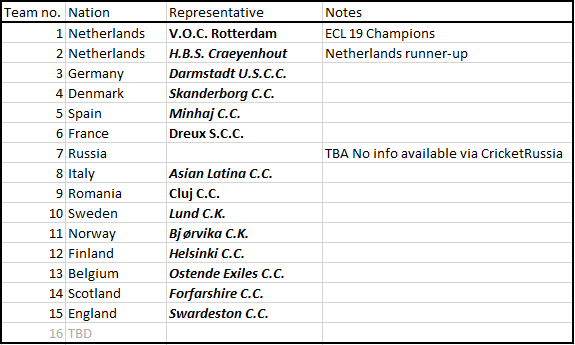
Today the European Cricket League (ECL) announces that England and Wales would be represented at the 2020 edition of the tournament by Swanderston C.C. of Norfolk. The news comes on the back of a major expansion by Daniel Weston and his team to include 7 new federations for this year (6 of which have been announced to date) and increase the ECL from 8 to 16 teams.

This is quite simply enormous news for the tournament. Whilst the 2019 edition made one hell of a bang, crowning Dutch champions V.O.C. Rotterdam ‘Kings of Europe’ and unearthing cricketing cult hero Pavel Florin, the 3-day tournament will not have created a big imprint in the wider cricketing culture, particularly because the nations represented were not major players on cricket’s world stage.

Announcing a 2nd Dutch team in H.B.S. Craeyenhout and Scotland’s participation through domestic champion Forfarshire C.C. will certainly have helped to flesh out the ECL’s potential, but with England involved it now has gravitas. The active presence of one of cricket’s ‘big three’ will capture more attention from a larger proportion of England’s not inconsiderate fanbase, and perhaps more crucially, its media. This obviously helps to make a bigger impact and it’s rumoured that the ECL is getting a bigger TV deal.

This is great news for the long-term future of the tournament, but it also comes with some drawbacks.

Firstly, what influence could the ECB have over the ECL? For instance, the Rachael Heyhoe Flint Oval at the La Manga Resort in southern Spain is the current host of the tournament. It provides a good wicket, excellent facilities and a wonderful setting for a cricket tournament but could the ECL come under pressure to host it in England instead?

Secondly, could an elevated presence from English cricket media skew the reporting? In the 2019 edition the teams received a fairly even amount of coverage, with the exception of champions V.O.C. Rotterdam and Pavel Florin’s Cluj C.C. of Romania. The tournament felt like an excellent promotional tool for cricket across Europe, but with the representation of one of cricket’s super-powers in England, could the teams who need the coverage to grow their domestic game be obscured by England’s shadow?

Finally, could we now see a dynasty of English dominance in the ECL? Of course, the standard set by the Netherland and Scotland at international level has never been higher, but there is still a large performance gap between them and the England side, could we see this reflected in the quality of the club cricket? Naturally those invested in the game at club level in associate nations will play very hard, and those teams will be bolstered by the inclusion of their international players which will raise their game, but with a larger player base in England and more resources directed at coaching, there are inevitably more talented cricketers.

These concerns may never be realised, and in which case the ECL is only going to go from strength to strength and will fufill Daniel Weston’s goal of making cricket a popular summer sport across the continent.

Whilst we’re here, two things remain unknown at the time of writing about the teams at this year’s event. Firstly, the identity of Russia’s representative, the Russian Cricket Federation’s website has been down for some time and the identity of their current domestic champion is anybody’s guess. Secondly, as eluded to earlier there is one federation who is yet to be announced. With the Netherlands, Scotland and England on board, it would be fitting for the final team to be Europe’s other top dog and full member in Ireland, whose current champions CIYMS Belfast boast test cricketer Mark Adair, and with five sides from Europe’s ODI nations, highly competitive cricket would be guaranteed.

Teams at the European Cricket League in 2020. Bold – Team confirmed by ECL, Italics – Team making ECL Debut

On the flip side, there may be some very disappointed associate boards who will not be represented in the 2020 edition, in particular Czech Republic, Austria and Channel Islands Jersey and Guernsey, all of whom had good years in 2019 and would have hoped to capitalise by getting a team on Europe’s big stage. That said, with 32 ICC members in Europe and only 16 berths in the ECL, there was going to be disappointment. There’s plenty of room to expand anyway.

ECL ’20 is going be absolutely nuts.

Cricket has a lot of formats, one more won’t hurt

A few thoughts on the 4-day test concept

When you stop to think about it, you quickly realise that cricket is played across a huge range of abilities and is played in numerous different ways. It’s actually one of my favourite things about the sport, no matter how talented or fit you are or aren’t, there’s a role for you in the game somewhere.

Most cricket is played over a single day, but that doesn’t mean it comes in a standardised form;

Professional one day cricket comes largely in two forms; the longer 50-over type, known as One Day International (ODI) between a select few nations, and List A between professional teams in certain countries. Not all international cricket 50-over gets one of the labels, and nor does all professional cricket get the latter. The shorter form, Twenty20 (T20) is globally more popular, and all matches between international sides that are ICC members are given T20I status. Both are played with coloured kits and a white ball.

That doesn’t mean to say they are the only kind of professional one day cricket. In the past few years a couple of T10 league have cropped up around the world. The ECB ran a 40-over competition from 1969 until 1998, before replacing it with a 45-over variant from 1999 to 2005 and returning to 40 overs for 2006, all this alongside and existing 50 over competition. In 2009 they dropped their 50-over competition in favour of keeping the 40-over version. England suddenly got rather bad at 50-over ODI cricket and so in 2014 they decided to replace the 40-over competition with a 50‑over one. Confusing.

This year the ECB is set to launch The Hundred, a variant of T20 but the game is made up of 20 five ball overs, running alongside the existing T20 competition. Sound familiar? I wonder where this is going?

Anyway, enough ECB-bashing. Amateur cricket comes in even more forms that it’s professional counterpart, and unlike the professional game, it’s normally played in whites with a red ball. In my 9-year senior ‘career’ hopping between various clubs in England I’ve played games scheduled at 50, 45, 40, 30, 25 and 20 overs! And let’s not forget that club cricket used to played on a timed basis, where one team would bat until they declared or were all out and used the rest of the time in the day to try and bowl out the opposition, if they didn’t the game would end in a draw! So kind of like a single innings, one day test match…

Multi-day cricket provides even more variations. Professional First-Class cricket is normally a 4-day affair, but in certain parts of the world, First-Class matches are limited to three days, as well as various 2nd tier championships. Some amateur leagues play two-day, two-innings cricket.

So when it comes to test-match cricket, it’s no surprise that there are plenty of variations too. The classical 5 days of 90 overs of 6 balls hasn’t always been so. The earliest tests of the late 19th century were timeless (though they rarely passed beyond the 4th day) and were played with 4-ball overs. The one-off test of 1882, famous for the birth of The Ashes series, was scheduled to be played over 3 days, but was completed in two. Overs were not standardised at 6 balls until 1901, and match lengths were not standardised until after the Second World War. 99 Timeless tests (4% off all test matches), without a pre-determined end point, have been played, continuing up until 1939. Further, additions to the test roster played some 4-day tests at the start of their timelines, the last of which was in 1973. Just when you thought that was it, Australia played a World XI in a 6-day test in 2005, although it only lasted for four of those days.

With this in mind changes to the format of test cricket aren’t exactly new, and 4-day tests shouldn’t be ringing alarm bells in the heads of any ‘purists’. Let’s put away the tradition argument and focus on the other points.

There’s a huge romantic notion to a game of cricket being played over 5-days. There’s time for a story to develop, heroes and villains to be established, a crescendo, and the potential for a fairy tale ending. It does make for great entertainment, but it’s not the only way it has be. After all, the ways we’ve chosen to consume media, news and sport has changed drastically in the last 20 years.

The next most obvious rebuttal of a 4-day test is that we’ll have a higher % of draws because of less game time. In an ideal world, a 4-day test would have a 98 over day, and so a 392 over match (compared with 450 overs for 5 days). Yes, that is a loss of game time of 13%, but on the other hand, only 4 tests out of 39 played in 2019 ended in a draw, all of which were affected by weather. Yes, rain is an inescapable part of cricket, but the days of big 1st innings score plays big 1st innings score and boring 5-day draws on flat wickets does seem to be behind us (at least for now).

Teams will play differently in a 4-day game, certainly, and there will be the loss of the fabled Fifth‑Day‑Thriller which goes to the final hour (Newlands 2020 the obvious and most recent example) but that’s not to say that a Fourth‑Day‑Thriller isn’t going to happen, it could well be more likely. And let’s face it, a match that ends in a draw having gone to the last over is just as exciting as one that gets a result (Cardiff 2009, anyone?).

The obvious win for the 4-day game is the reduction in the cost of hosting a game. Costs for a 5-day test aren’t really important if you’re the BCCI, ECB, or CA and test-match cricket is profitable. But if you’re in South Africa, the West Indies, New Zealand, where boards don’t make a profit out of a test match and the loss is being offset by short-form cricket, the costs suddenly count for a lot more. Let’s not forget the newest test sides, Ireland and Afghanistan who have recently been shelling tests left, right and centre because the can’t afford to host them. Afghanistan can’t recover costs by selling tickets because they can’t play in front of a home crowd, and it’s well publicised that the cost of hosting a test match in Ireland is ~€1 million when accounting for the construction of an maintenance of temporary stands, security and facilities. That equates to something in the region of 12% of their entire annual budget (at the time of writing it’s expected that all 4 of Ireland’s proposed test matches in 2020 will be indefinitely postponed or cancelled)

For the smallest boards, 4-day tests could be a lifesaver. For medium sized boards, the 4-day test seems like a tantalising cost saving measure at a time when budgets seem to be stretched increasingly thin. Financial crises among even the more established nations is causing waves across the test arena and we do need to find a way to address it.

Of course, we shouldn’t just knee-jerk into playing only 4-day tests, we’ve only has 2 in the last 45 years so there are a lot of unknowns as to how it would go down. With this in mind, it’s probably worth experimenting with 4-day games outside the World Test Championship to better influence a decision in the future.

Should 4-day tests be the default for the 2021-2023 WTC? No.

Should we completely dismiss the idea? Absolutely not.

Netherlands – 2019 Season Review

Results Summary:

ODIs:     P 2          W 2        L 0          T 0          N/R 0

T20Is:    P 22        W 12      L 7          T 1*        N/R 1

*Tied game vs Zimbabwe was lost in a super-over

By comparison to their European counterparts in Ireland and Scotland, the Dutch have had a much quieter year, but not one without incident or drama. Coach Ryan Campbell’s goals for the year were to expand the pool of players ready for selection in international cricket, and to qualify for the 2020 T20 World Cup. Both of those goals were achieved.

Netherlands started the year along side Ireland and Scotland with a T20I quadrangular series in Oman. They claimed the opening game of the tournament against the Scots, chasing down 154 with 1 ball to spare and win by 7 wickets thanks to a solid 71* from opener Tobias Visee. The took the second game against Oman as well, despite Oman surging to a competitive total of 166/4, the Dutch top 4 all fired to get them over the line with 7 balls to spare.

Knowing they needed to win or tie the final game against Ireland to take the series, they got off to a flying start through Visee and O’Dowd, making it to 116/0 in 9 overs. From there they were pinned back by a flurry of wickets but made it to 182/9. Fred Klassen and Paul van Meekeren kept the Irish chase largely in check with 7 wickets between them, Ireland needed 12 off the last over, which was then reduced to 6 off the last ball. They couldn’t defend it, and the loss pulled them back to finish the series in 2nd place.

The Dutch would then have to wait until June for their next international outing, when Zimbabwe toured for 2 ODIs and 2 T20Is. Bowling first in a game shortened to 47 overs per side in the 1st ODI, the bowling attack combined to take early wickets and restrict the tourists to 205/8. The chase then pinned around an unbeaten 86 from ODI debutant Max O’Dowd, and the hosts cruised to victory.

The 2nd ODI was a less straightforward affair. Again bowling first, they were unable to break down the opposition like they did in the first ODI as Craig Ervine, Brendan Taylor and Sikanda Raza helped Zimbabwe post 290/6. Knowing that they’d need to produce their highest ever successful chase to claim the series, the Dutch got of to a strong start but slipped away and by the 33rd over they were 167/5. A quick 50 from Roelof van der Merwe and back up from keeper Scott Edwards kept them in the chase, but when captain Peiter Seelaar smashed 32 in 15 balls, the hosts were suddenly ahead of the game. The took the match with 4 balls to spare and in doing so took their first ever ODI series win against a full-member.

Next, the T20I series, and the hosts picked up where they left off, rapid fifties for both Cooper and van der Merwe as they set a total of 199/6. The Zimbabwean response started well but quick wickets in the middle of the innings from Seelaar and Klassen took the wind out of the visitors sails and the Dutch won by 49 runs.

Mirroring the ODIs, the 2nd T20I was a much tougher test. Despite a fifty for O’Dowd at the top of the order, the Dutch could only make 152/8 in 20 overs. They managed to hold Zimbabwe to 97/6 after 14 overs but Burl and Chigumbara put the visitors back in the driving seat, so much so that they only needed 1 to win from the final 4 balls. Cue a dot ball followed by a van der Merwe ‘hattrick’, a tie and a super over. Despite the normal-time comeback, the hosts could only manage 9 in response to Zimbabwe’s 18, so the series finished 1-1.

August saw The Netherlands host the UAE for 4 T20Is. With many of their star players in Canada for the GT20, Ryan Campbell used the opportunity to try-out some younger players and test the bench strength. The host were outplayed in all 4 matches and lost the series 4-0. Whilst some of the more established players in O’Dowd and Cooper fired, the younger players failed to make a serious impression, with legspinner Philippe Boissevain and medium-pacer Sebastiaan Braat making the most impact.

This would be the first of a series of T20I wobbles from the Dutch. With their stars back from franchise cricket, and in the absence of the Euro T20 Slam, the team headed for Dublin for a tri-series with the other affected European nations. Game 1 against Ireland was washed out, and when they came up against Scotland in game 2, they were faced with the brute force of George Munsey and Kyle Coetzer. The 200 run opening stand the put on culminated in a total of 252/3. The Dutch simply had no answer. Max O’Dowd’s solitary over went for 32 runs. Seelaar made a 49 ball 96* in reply but the Dutch fell a whopping 58 runs short.

The bounced back in game 3, keeping Ireland to 181/7 with Brandon Glover taking 2-19 from 4 overs, and then chasing down through a 144 stand between O’Dowd and Cooper, the latter making 91*. Their final game saw them slump again. Batting first against Scotland, none of their batsmen got going and in the face of Scotland’s spin attack were bowled out for 123. Scotland knocked it off with ease and the Dutch finished in 3rd place.

Ahead of their final test of the year – the T20 World Cup Qualifiers in the UAE – the Dutch prepped with a pentagular series in Oman against Ireland, Hong Kong, Nepal and the hosts. Their first match saw them take on rivals Ireland. A 65 from Ben Cooper helped raise them to 167/7, but they were unable to take wickets to hold Ireland back, who completed the chase with 11 balls to spare. In the second game against Nepal, the Dutch batting struggled against the bowling of Lamichhane and Karan KC, and they were bowled out for 133. In reply, the bowlers gritted their teeth and got stuck in, restricting the opposition for much of the match and leaving the Nepalis with 17 to win from the last over, but could not defend it, losing by 6 wickets with 1 ball to spare.

Next up were hosts Oman. This time the Dutch batting collapsed against the spin of Khawar Ali and Zeeshan Maqsood who took 4 wickets each as the Netherland were skittled for 94. The hosts needed to make minimal effort to complete the chase. The final game came against Hong Kong, and the Dutch batting finally started to come together with fifties for Visee and van der Merwe and a flashy 40 from Scott Edwards producing a total of 185/4. Glover and Seelaar were then able to keep a lid on things as Hong Kong could only post 148/7 in reply and the Dutch avoided the wooden spoon.

Going into the qualifiers questions were asked of the Netherland’s form, having won only 2 of their previous 11 T20Is and losing both their warm-up games. Grouped with Scotland, Namibia, PNG, Singapore, Kenya and Bermuda, they still had strong odds of qualification, but looked under-pressure.

Any pressure they were actually feeling was released in their first game as they cruised past Kenya as Max O’Dowd made a 50 in the Dutch total of 166/4. Despite resistance from veteran Collins Oboya, tight bowling and early wickets allowed for a 30-run win. They then swept aside Namibia, the seamers bowling out the opposition for 96 to win by 44 runs, and followed it up by skittling a surging Singapore for 101. Despite wobbling at 65/5 in the chase, van der Merwe and Colin Ackermann saw the Dutch home to their third straight win.

Now in a strong position, game 4 saw them take on PNG. This proved a much tougher test as the Barramundis kept the Dutch under intense pressure in the field, keeping the Boys in Orange to 126/7. The total proved too little, despite the strong Dutch bowling and PNG took the game by 5 wickets. Up against Bermuda, the Dutch bounced back, making a mammoth 206/3 built on a record 1st wicket stand of 123 from O’Dowd and Cooper and then demolishing the Bermudian batting to win by 92 runs.

Going into the final game against Scotland, the Dutch knew they needed to win comprehensively to overcome PNG at the top of the table. Clever bowling at the Scottish batsmen help restrict them to 130/8, meaning the Dutch would need to get to 131 in 12.3 overs to top the group. It didn’t materialise, loosing early wickets. An unbeaten fifty from Ryan Ten Doeschate saw them home, but the Dutch would finish 2nd and as such proceed to the playoffs.

In the qualifier playoff against the UAE, the five Dutch seamers shredded the opposition batting, reducing the top order to 9/5 in the first 5 overs. Brandon Glover took 4-12 and the UAE only managed 80/9. The Dutch barely wobbled in the chase, and completed their qualification.

But one more prize remained. They took revenge against Ireland in the semi-final, 158 proving too strong a total for the Irish. In the final, the met PNG for the second time. This time bowling first, they were able to keep the pressure on PNG, with Glover and van der Merwe taking the lion’s share of the wickets as the Barramundis were kept to 130/8. The Dutch weren’t given full control of the game, but led by the experience of Ten Doeschate and Ackermann saw the Dutch get over the line with an over to spare, and take home the trophy.

Despite a late summer wobble, 2019 has been an excellent year for Dutch cricket, exceeding expectations in both ODI and T20 cricket. It sets up well for what will be a huge couple of years for the associate nation with the possibility of two T20 World Cups and the ODI Super League coming up.

The Netherlands have already got some huge fixtures lined up in 2020. Their home summer sees them host New Zealand for a T20I in June. They will also host Namibia, the USA and Oman for an ODI quadrangular series in late June, before the jewel-in-the-crown, hosting Pakistan for 3 ODIs at the start of July in the first of their Super League campaigns. In September, they will travel to Zimbabwe for what will be on of the most crucial Super League series if the Dutch are to avoid a 13th place finish. Finally, October sees them taking on Bangladesh, Scotland and Namibia in the first round of the T20 World Cup, and with an extra spot available in the 2nd round, there is an opportunity for even more big games.

Scotland 2019 Season Review

Results Summary:

ODIs:     P 9          W 4        L 5          T 0          N/R 3

T20Is:    P 15        W 9        L 6          T 0          N/R 0

On the back of a stellar 2018, beating England in and ODI for the first time and missing on the 2019 World Cup only at the hands of a dodgy umpiring decision and the rain, Scotland’s 2019 was very much a comedown from such a high, and has put their status as the leading associate under threat.

Scotland started their year in Oman in February as part of the T20I Quadrangular series with Ireland, Netherlands and the hosts. Favourites to win outright, they stumbled in their first game against the Dutch, failing to post a strong total despite a 50 from Callum MacLeod. After the Irish got off to a flyer in game 2, Mark Watt took the game by the horns with 3-26 to restrict Ireland to 180. George Munsey and Captain Kyle Coetzer did the rest, laying a platform for a 6-wicket win. They then brushed aside Oman, and with Ireland beating the Netherlands, it was enough to give Scotland the trophy on NRR.

Scotland then took on Oman in a 3-match List A series. The first game saw Scotland’s seamers rout Oman, bowling them out for 24, a record low total in an international list A fixture. Needless to say, Scotland won comfortably, taking only 22 balls to chase down the target. The following day, Oman fought back and made 248/8, and Scotland were bowled out for 155. Game on. The decider looked to be going Oman’s way as well, Scotland restricted to 160/3 at the 40 over mark. Cue George Munsey, who walloped a 43 ball 96 including 9 sixes to help Scotland post 303/5. That turned out to be just enough, as Oman ended 16 runs short of the target.

Scotland’s home summer was one of two halves. The first half saw Afghanistan and Sri Lanka visit in May as part of their World Cup preparations, each for a 2-match ODI series. The first match against Afghanistan was washed out, but in the 2nd game Scotland raised an imposing 325/7 following a Callum MacLeod century. Scotland looked ahead for most of the chase, but just as the game reached its climax, the rain came down with Afghanistan 2 runs ahead on DLS.

Much like the Afghanistan series, the first ODI against Sri Lanka was washed out. In the 2nd ODI, Scotland fought back after a poor start, but Sri Lanka posted a solid 322/8. Despite a good start to the chase Scotland fell away and when rain became too heavy after 27 overs, Scotland were 132/3 and 33 behind on DLS. When the rain cleared, the revised target was 103 from the remaining 7 overs. Despite some fireworks from Munsey, Scotland never came close.

Once the world cup had passed, Scotland had the honour of opening up the new qualification pathway for the 2023 World Cup by hosting the first leg of Cricket World Cup League 2, a tri-series against Oman and Papua New Guinea in August. The Scots, perhaps a little stunned by the cancellation of the Euro T20 Slam earlier in the week, stumbled in their first game against Oman, being bowled out for 168 on a slow surface and not making inroads in the Omani batting line up. They took their first win after squeezing past PNG by 3 wickets in a chase of 206, built around a 96 from captain Kyle Coetzer. Game 3 saw them return to form by blasting out Oman for 138 to win by 85 runs, including a breakthrough performance for Hamza Tahir who took 5-38. Finally, they beat PNG by 38 runs to claim the series and top the table.

In the absence of the ET20S, Scotland travelled to Dublin for a tri-series with Ireland and the Netherlands. The Saltire’s first game against the Nethelands saw a record breaking batting performance, posting 252/3 in 20 overs, the 6th highest innings total ever in T20Is. The innings also saw the 3rd highest partnership in T20I history between Coetzer and Munsey, making 200 together. Munsey went after individual records too, his 127* from 56 balls being the highest score for a Scot in T20s, as well as the 5th fastest T20I century off 41 balls, and the 2nd most sixes in a T20I innings. In reply, the Dutch fell a mighty 56 runs short.

They couldn’t quite repeat it the following day, however. Despite posting 193/7 in 20 overs, hosts Ireland knocked off the total with 14 balls to spare. Game 3 then saw the Scots skittle the Dutch for 123, Hamza Tahir taking 4-30 and Scotland winning by 6 wickets. In the final game, which would decide the series between Scotland and Ireland, Scotland were set 187 to win. With 4 overs to go, the Scots were 154/2, needing 33 to win and Richie Berrington hitting the ball cleanly. However the game was turned on it’s head with 3 wickets in quick succession, leaving Scotland needing 15 off the final over, and then 4 off the last ball. A missed scoop-shot of the last ball meant Ireland took the game by 1 run and the series with them.

Scotland’s prep for the T20 World Cup Qualifier saw them travel to South Africa when just about everyone else prepared in the middle-east. They won both games against the Dolphins, before moving on to the UAE, where they lost their opening warm up game against the UAE and beat Ireland by 1 run in the second.

Scotland’s group contained Netherlands, PNG, Namibia, Singapore, Kenya and Bermuda. Starting the tournament as the highest ranked team, the Saltire’s should have been expected to win the bulk of their games and if they didn’t win the group, finish a close 2nd. However, they suffered a ‘shock’ defeat in the first game at the hands of tournament debutants Singapore. Off to a flyer thanks to Munsey, at 70/0 in the 8th over Scotland looked to be well on track to chase 169. Singapore pulled it back with regular wickets, but Scotland only needed 8 from the last with MacLeod in on 44. Losing 3 wickets in 4 balls, Scotland lost by 2 runs.

Normality was restored with a 31-run win over Kenya, even if the 170 total Scotland posted looked sub-par halfway through the Kenya chase. Scotland then squeezed past PNG, Josh Davey dismissing both set batsmen in the first two balls of the final over to defend 146. They played their 4th game against Namibia the day after, and without captain Coetzer due to dehydration. Namibia put up a solid 159/6, and Scotland were in the chase until a flurry of wickets reduced them from 67/2 to 107/8, eventually losing by 24 runs. The pressure was squarely back on Scotland.

After that, all of Scotland’s games were in the main stadium. Firstly, against Bermuda, where MacLeod ballistics allowed Scotland to raise their first 200+ total of the tournament. Bermuda fell a long way short. Going into their final game against the Netherlands, Scotland were guaranteed of a playoff spot, but could not top the group and qualify automatically. Defeat, however, would put them in a do or die playoff. Scotland could only raise 130/8 batting first, and the Dutch knocked it off with ease. 3 wins and 3 losses in the group stage, Scotland were offered one chance to save their campaign.

In their eliminator playoff against the UAE, Scotland batted first and immediately took the game by the horns. Munsey produced a barrage of sweepshots and 5 sixed in his 65, whilst Berrington made 48 of only 18 balls as Scotland powered to 198/6. The bowlers picked up where the batsmen left off, Sharif and Davey reducing the Sultanate to 12/2, before they were bowled out for 108. Scotland had booked their place in the World Cup, even if they had to go the long way ‘round. They finished the campaign by easing past Oman for 5th place.

Scotland’s final test of the year saw them return to the UAE at the start of December for a CWCL2 tri-series against the USA and the hosts. Scotland being Scotland, they were remarkably followed by the weather, with heavy rains hitting the Emirates during the week in question. Despite Sharif knocking over Xavier Marshall’s stumps first ball of the match, the USA were able to raise 282/8 in their first encounter. Scotland’s chase looked under control, 112/2 at the midway point, but regular wickets in the second half of the chase and a collapse of the tail saw Scotland all out for 247.

Their second match, against the UAE was completely washed out. When they returned the two days later to take on the USA for the second time, their performed more strongly, restricting the USA to 245/9. Despite only MacLeod surpassing 50, Scotland managed the chase well to win by 4 wickets. Their final game against the UAE saw Cross and Coetzer get Scotland off to a great start with a 138 partnership, and the two going on to make 53 and 95 respectively. No one else was able to back that up and the Scots were bowled out for a sub-par 220. The UAE made light work of the chase, taking the game by 7 wickets with 5 overs to spare.

Scotland’s year has not lived up to the level they set in 2018 when the beat England. Whilst it’s very easy to say that the field in associate T20 cricket is highly competitive, the billing that the Scot’s are the leading side at this level has not been fulfilled this year. Three defeats in the group stages of the T20WCQ and 3 defeats in their first two legs of CWCL2 puts the tag in question…

One of Scotland’s perceived strengths in both formats is their batting. There is plenty of talent in that batting line up and they have all shown it but often it has come on very good batting surfaces. Move them away onto slower tracks, especially the kinds we’ve seen in CWCL2 so far, and they haven’t been able to produce runs as freely. It could continue to cost them in away series and may encourage them to move home series to Scotland’s faster tracks, in particular The Grange.

Scotland finish the year 2nd in CWCL2, 3 points behind leaders USA. 2020 sees them travel to the States in March to resume their competition with the USA and UAE. They will also travel to Namibia in April for a CWCL2 series, the third team being Nepal, before hosting both in Scotland in June/July.

Scotland’s flagship games for 2020 see them play host to New Zealand and Australia. They host the former of the two for an ODI and a T20I as the Kiwi’s kick off their European tour in Edinburgh. It’s will be the first time Scotland have hosted New Zealand since the 1999 World Cup. Australia will visit for a T20I on the 29th of June.

Scotland will close out their year with the T20 World Cup, where they play Bangladesh, the Netherlands and Namibia in Hobart in the first round but will have a keen eye on a place in the Super 12s.

There was also a rumoured ODI against England at Lord’s, though whether talks continue about this is unclear. A game against England would be another boost to the profile of Scottish Cricket, especially with the TV coverage that comes with it. On a related note, the deal between Cricket Scotland and the ECB containing the currently unused TV rights for Scottish cricket expires in 2020. It means Scottish home internationals against teams other that England could have a TV broadcast as soon as 2021, which would be a boost to CS’ budget and profile.

Ireland – 2019 Season Review

Ireland 2019 Season Review:

Results Summary:

Tests:    P 2          W 0        L 2          D 0

ODIs:     P 13        W 6        L 7          T 0          N/R 2

T20Is:    P 25        W 13      L 10        T 0          N/R 2

Ireland’s 2019 is a tale of reasonable results, mixed fortunes and some serious woes. Despite pretty even records, particularly in the white-ball formats, Irish fans will look back on 2019 and likely consider how the team didn’t quite meet their potential, both on the field, and later off it.

Ireland’s year began in Oman in February, with a T20I quadrangular series against Scotland, the Netherlands and the afore mentioned hosts. Coming into the tournament on the back of some poor results in the shortest format in previous years, Ireland exceeded expectations beating Oman and breaking their 5-year curse against the Dutch. This looked partly to be the result of moving their batting all-rounder and talisman Kevin O’Brien to the top of the order to partner Paul Stirling, but was also aided by performances by some youthful additions to the Irish squad, including Josh Little and Shane Getkate. Despite 2 wins out of 3, Ireland finished third, tied on points with Scotland and the Netherlands, but on a weaker net run rate.

Ireland then moved on to Dehradun in North India to take on Afghanistan in a multi-format tour. Starting with three T20Is, Ireland were demolished at the hands of the Afghani batting, which included the Afghans equalling the T20I record total of 278 in the 2nd T20I, with a 62-ball 162 from Hazratullah Zazai. Despite some hefty hitting in return, Ireland never really threatened the Afghani totals.

The 5-match ODI series was a different story. Comprehensively beaten by the spin of Mujeeb Ur Rahman in the 1st ODI, bowled out for 161, and with the 2nd ODI washed out, Ireland hit back in the 3rd game; Afghanistan were reduced to 74/5 in the 19th over by a combination of Irish bowlers. Ashgar Afghan and Najibullah Zadran steadied the ship, and lifted Afghanistan to 256/8, which looked a good total. And it may have been a winning one but for a brilliantly measured 145* from Andy Balbirnie, backed up by George Dockrell which levelled the series at 1-1. Ireland were then flattened in the 4th ODI, bowled out again for 114, before fifties from Paul Stirling and Andy Balbirnie in the 5th ODI helped to draw the series 2-2.

Ireland and Afghanistan each moved on each to their 2nd ever test match. Batting first, Ireland were skittled to 85/9 in the first two sessions. If not for a punchy 54 from no. 11 Tim Murtagh restoring Ireland to 172 all out, it could have been a lot worse. From there on, the teams were quite even, Afghanistan making 314 in their first innings, Ireland 288 in their second with Balbirnie top-scoring with 82. Afghanistan were set 147 to win, which they knocked off with 7 wickets to spare. Ireland very much lost the game on the first morning.

Ireland’s home summer began with an ODI against England at Malahide. ODI debuts were awarded to James McCollum, Josh Little, and on the back of a late injury to Stuart Thomson, Mark Adair. Rain shortened the match to 45 overs a side, but when the game got going it turned into a cracker. What looked to be a low total was raised to 198 by a punchy 32 from Adair. England then collapsed from 34/0 to 66/5 and then 101/6 following a destructive spell from Little. Had they chosen to review an incorrect LBW call on Ben Foakes, they may have run through England for the win, but Foakes and Curran dug the visitors out to win the game by 4 wickets.

Ireland then played host to the West Indies and Bangladesh in a 7-match tri-series in Dublin. This turned out to be a poor series for the Irish, comprehensively beaten in all three completed games, including a 196 run walloping at the hands of the West Indies at Clontarf, in which Campbell and Hope produced a world record 365 run opening partnership. Small positives came in the form of a high volume of runs for Stirling and Balbirnie in the three completed matches.

The next series was at home to Afghanistan in Belfast as apart of the visitors World Cup preparations. The 2-match series was drawn 1-1; Ireland comprehensively winning the first game through an all-round bowling performance including 4-19 from Adair and a miserly 0-17 from 10 overs from spinner Andy McBrine. The second game was one-sided in favour of the visitors, a Mohammed Shazad century creating a target well out of the reach of the hosts.

Ireland would then wait a month for their next international action, hosting fellow World Cup exiles Zimbabwe in 6 match white-ball tour. Ireland took the ODI leg 3-0, their first ODI series whitewash over a full member. Despite the series scoreline looking one-sided, the first two ODIs could have gone either way, the second only won by 5 runs. The T20I leg saw Ireland play a very youthful side; along with the afore mentioned Adair, Ireland turned to their youngsters including Shane Getkate, Gareth and David Delany in preparation for the T20 World Cup qualifiers. The series was drawn 1-1; the first match was washed out, Ireland won the second after a Stirling masterclass but were undone by strong Zimbabwean batting in the third.

In the 2nd ODI against Zimbabwe, veteran Tim Murtagh picked up his first international five-for. He wouldn’t have to wait long for his second. In Ireland’s historic first test match against England at Lord’s, William Porterfield won the toss and elected to field. Handing the new ball to Middlesex seamer Murtagh and test-debutant Adair, the Irish bowling attack ripped through the England batting line up, perhaps bleary-eyed following their World Cup win on the same ground 10 days prior. Murtagh claimed 5-13 in the session as England were all out for 85 at lunch. Ireland’s batting faired a little better, with Balbirnie adding his second test 50, though by the close of day 1 they too were all out for 207.

Day 2 saw England recover, and Ireland frustrated by a stellar 92 from night-watchman Jack Leach. England were bowled out for 303 on the first ball of day 3, but from there, under a grey sky at Lord’s, it suddenly went very dark for Ireland.

Set an inviting 182 for an historic first test win, Ireland crumbled at the hand of Chris Woakes and Stuart Broad. In the morning session of the 3rd day Ireland were skittled for a mere 38, the 5th lowest total in test history and only McCollum reaching double figures. What could have been Irish cricket’s greatest day turned out to be on of their most horrid.

A little time to recover was increased by the cancellation of the Euro T20 Slam. In its absence, the three aggrieved boards played a 6-match tri-series at Malahide as prep for the T20 world cup qualifiers. Ireland’s first game against The Netherlands was washed out. They lost their other game against The Netherlands but beat Scotland in both fixtures, including a 1 run win in the final game that saw them top the table. As well as established figures such as Balbirnie and Stirling making runs, Ireland’s younger stars stepped up, including match winning performances from Adair and Gareth Delany.

The last warm up before the world cup qualifiers came as a pentangular series in Oman along with Nepal, Hong Kong and The Netherlands. 3 wins from 4 games left Ireland 2nd, beaten by champions Oman. The form looked sufficient to qualify, having beaten the Dutch and brushing aside Hong Kong in representative conditions. The Hong Kong win also saw Kevin O’Brien make his first T20 century, and the first for an Irishman in T20Is. In doing so, O’Brien also became the first Irishman to make a century in all 3 international formats.

So onto the qualifier itself, Ireland’s last on-field test of the year. Grouped with hosts UAE, Oman, Hong Kong, Canada, Jersey and Nigeria, the Boys in Green would have backed themselves to qualify for the playoffs without much difficulty, and they started so, once again cruising past Hong Kong on the back of a pair of fifties from Stirling and Balbirnie. In the second game against the UAE, they crumbled, posting 125 all out and losing by 5 wickets. Now on the backfoot, and against an in-form Oman in their 3rd game, an unbeaten 89 from Gareth Delany set an imposing 184 to win. Delany then went on to lead the attack, taking two early wickets as Ireland won by 35 runs. Ireland’s fate was back in their hands…

But only for 24 hours. Game 4 vs Canada saw Ireland never really take control and chasing 157 to win, fell 10 runs short. Once again, Ireland’s fate was out of their hands. Their final two games against Jersey and Nigeria were expected to be smooth sailing, but they needed to win big to boost their net run rate and aid their qualification chances. Jersey were bowled out for 105, and the target chased in 14 overs. Nigeria were kept to 66/9, Ireland completing the chase in 6.1 overs. The wins were a sufficient boost for their NRR, and meant they had qualified for the playoffs, but to qualify automatically would require Oman to slip up against Jersey. Of course, somehow Jersey pulled off an unlikely victory and Ireland topped the group, proceeding directly to the semi-finals.

Ireland faced a resurgent Netherlands in the semis, and they were comprehensively beaten, making only 137/9 in pursuit of 159. It led to a 3rd place playoff against Namibia, and despite a poor batting performance, bowled out for 135, tight bowling from Adair and backed up by spinners Delany and Singh, Ireland bowled Namibia out for 108, securing 3rd place.

On the field, Ireland will be a little bit disappointed with their performances. Let down by two poor sessions with the bat in their two test matches in games that were otherwise balanced, middle order stability in the test side will need to be a focus in the future. A fairly even record in ODI cricket looks good, but it was mostly narrow wins, and mostly heavy defeats. In the T20s despite a few wobbles across the year, signs of a new era of talent are evident. As the members of the ‘Golden Generation’ that saw them create huge upsets at 3 world cups approach their retirement, young stars are starting to break through. Above all, Mark Adair has been the player of the year, making a huge impact with bat and ball and across all 3 formats. But also, good young spinners in Gareth Delany and Simi Singh and genuine fast bowlers in David Delany and Josh Little are emerging. A handful of talented batsmen, James McCollum, Lorcan Tucker and Harry Tector are showing potential to blossom.

But it’s the off-field struggles that will leave a sour taste in the mouth at the end of the year. With their promotion to full members, Irish players have been unable to sign contracts as domestic players in England’s county system. All of the existing contracts have now expired, and this has led to some difficult decisions for a handful of Irish internationals. Whilst Paul Stirling has made the decision to return from Middlesex, veterans Stuart Poynter and Tim Murtagh have called time on their international careers to extend their county contracts.

Ireland’s financial wobbles are well documented. A board that aims to be as self sufficient as possible, to the extent that until this year had never taken out a loan of any form, had to be bailed out very briefly by CEO Warren Deutrom after a broadcast deal failed to pay up in time. Ireland’s financial woes were compounded just before Christmas when they announced that the planned home test vs Bangladesh was to be cancelled and replaced by an additional T20I as hosting the test would stretch the budget too thin. The proposed T20I series against Afghanistan was simultaneously cancelled. Days later, it was announced that the away test vs Sri Lanka was to be ‘postponed’ due to a lack of a broadcast deal.

Cricket Ireland raises a reasonable proportion of its own money but is set up to run with very little in the way of reserves, and hence no buffer room if something goes wrong. Additionally, CI receives around $5m from the ICC, less than half that of Zimbabwe. It means every penny has to be efficiently spent, and such any loss in potential revenue hits hard. In the wake of the cancellation of the Euro T20 Slam, it’s likely CI has seen no return on its investment, and the loss of money has resulting in the curbing of fixtures for 2020.

Despite the loss of half their planned test matches, there is still much to look forward to for Ireland in 2020. They start up immediately in January with a 6-match white ball tour of the West Indies, their first as full members. They will also have 3-format tours to rivals Afghanistan and Zimbabwe in a busy winter.

The home summer sees Ireland host Bangladesh for 4 T20Is (potentially hosted in England due to the refurbishment of Clontarf) and 3 ODIs, including the first game of the ODI Super League. They will also host New Zealand for 3 T20Is and 3 ODIs as part of the Super League, and then 2 T20Is against current world no. 1 Pakistan at the end of June. July and August are currently clear, and so the ET20S may yet return. September sees Ireland take on their third Super League series away in England. Finally, in October Ireland travel to Australia for the T20 World Cup, in which they are grouped against Sri Lanka, Oman and Papua New Guinea in Geelong. With an extra qualifying spot available for the 2nd round, Ireland will fancy their chances of extending their trip.
Design a site like this with WordPress.com
Get started